
It comes down to current
Think of voltage as pressure and current as flow. Power is the two multiplied together, so the same job can be done as a lot of flow at low pressure, or less flow at higher pressure.
Current is what makes life difficult. For roughly 3000W of load, before inverter losses, the DC side carries about 250A at 12V, about 125A at 24V, or about 62.5A at 48V.
Less current can mean smaller practical cable, less voltage drop, less heat in cables and terminations, and easier switching and protection. It does not automatically mean thinner or cheaper cable — cable still has to be sized for the current it carries, the drop over its length, how it is installed and how it is protected.
Where 12V works well, and where it stops
The caravan aftermarket is built around 12V. Fridges, water pumps, lights, diesel heaters, fans, chargers, sockets — the lot. Parts and replacement gear are widely available, and there is an enormous amount of established RV equipment built around it.
Large 12V systems are possible too. Sizeable 12V inverters exist, and a well-designed 12V system with a suitable inverter will run a caravan air conditioner, an induction cooktop or a microwave.
The catch is that 12V gets expensive to do properly long before it becomes impossible. Once you are specifying very heavy cable, high-current fusing, batteries in parallel and a BMS chosen for sustained output, you start spending more money managing current rather than adding useful capability. That is when the voltage question is worth asking seriously.
When higher voltage starts to make sense
12V can do nearly everything 24V can. The question is whether it is still the sensible way to do it. These are the things that shift the answer:
The DC current gets large
A large inverter running hard can ask a 12V bank for hundreds of amps. That means very heavy cable, high-current fusing, substantial busbars, and terminations that have to be right. All of it is achievable. It just gets harder, heavier and dearer to do properly as the numbers climb.
The battery has to deliver it too
Cable is only half of it. The battery bank and its BMS have to supply that current continuously. At high power that can mean several batteries in parallel, a BMS genuinely rated for the job, heavy interconnects, and high-current isolation and protection. Doubling the system voltage halves the current for the same power, which makes the whole DC side easier to engineer properly.
Your load profile, not your appliance list
Owning an air conditioner does not mean you need 24V. What matters is how much runs at once, and for how long. Running one 2000W appliance for ten minutes is a completely different job from expecting several kilowatts of 240V load to be there for hours.
Long runs carrying high current
Distance and current together are what hurt. A long run carrying a lot of current needs heavy cable to keep the voltage drop in check. At some point the cable to do that properly at 12V costs more than solving the problem another way.
Before you blame the voltage
Lights dimming, an inverter dropping out, a microwave that struggles — that is usually not a sign you need a different system voltage.
Far more often it is undersized cable, poor connections, voltage drop over a long run, battery sag, a BMS hitting its current limit, or a marginal isolator or fuse holder. Sometimes it is simply a system that was never designed for what is now being asked of it.
The first job is finding out which. Only once a system is otherwise right, and the current required is still becoming unmanageable, does the voltage belong in the conversation.
The cost of doing it twice
This is worth settling before you commit to anything, because it is where the real money is.
Changing system voltage later is not a battery swap. The inverter, solar controller, mains charger, DC-DC charger and battery monitoring are all voltage-specific. Convert a 12V van to 24V down the track and much of that equipment may need to be replaced rather than reused — and the labour can approach a second full installation.
Building at the right voltage the first time usually costs a little more up front and considerably less over the life of the van. If you are already spending serious money on lithium and solar, answer the voltage question properly rather than defaulting to 12V because that is what you have always had.
Same logic one level up. If the system you are sizing is already pushing 24V hard, it is cheaper to ask the 48V question now than to arrive at it in three years.
What moving to 24V actually involves
Going to 24V is a system decision, not a battery swap.
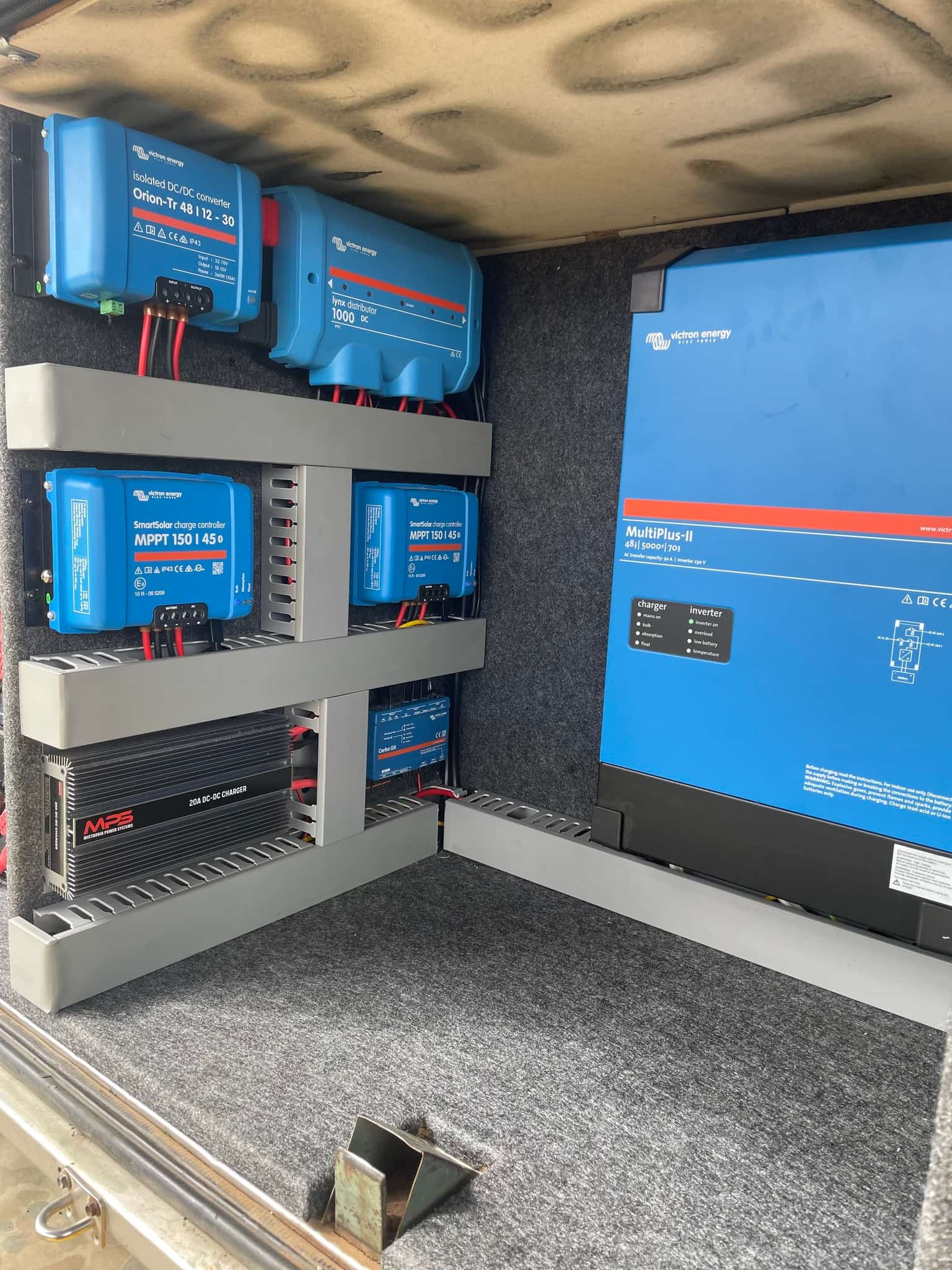
The house batteries, inverter, solar controller, mains charger and battery monitoring all need to suit 24V. Your tow vehicle almost certainly still supplies around 12V, so charging the van while driving needs equipment designed to step that voltage up and charge a 24V bank correctly.
Most of the van's existing 12V equipment can stay where it is. A correctly sized 24V-to-12V converter supplies the 12V distribution side, and that is a normal part of a 24V installation.
Some gear needs no converting at all. Many modern compressor fridges accept either voltage, and diesel heaters are available in 24V. But appliances have to be checked one at a time rather than assumed.
Be honest with yourself about where the system is heading, too. If your list already has a large bank, a big inverter and air conditioning you want to run for hours, 24V may be the compromise rather than the answer — and that is a far better conversation to have now than after the gear is bought.
Where 48V fits
48V earns its place when a system is genuinely built around high power — a large inverter, a large lithium bank, significant daily 240V use, sustained air conditioning, induction cooking, and the solar to match. It is not simply the next step after 24V.
The reason manufacturers are heading there is current. At 48V, a 4000W inverter asks for roughly a quarter of the DC current the same inverter would need at 12V. The high-current DC side gets dramatically easier to manage.
It is turning up in production vans, too. Jayco now has a dedicated 48V Adventurer and offers 48V power-system options on some other models, so people are seeing it on a showroom floor before they ever speak to an installer. The Adventurer is a fair illustration of the use case — a 5.05kWh 48V battery and a 4000W inverter, with the solar and the cooking to match.
Far fewer RV appliances run directly from 48V, so a 48V installation has two sides to it: the 48V battery and inverter doing the heavy lifting, and a 48V-to-12V converter feeding the conventional lighting, pumps and other 12V gear.
Charging from the vehicle is where it gets interesting. A large 48V bank can absorb a lot of energy, so vehicle charging needs thinking about in watts, not amps. A setup that looks respectable in amps can still contribute relatively little energy to a large bank, especially once air conditioning is in the picture. Factory systems are designed around a known battery, solar and charging package. On a retrofit, those pieces have to be engineered together rather than assuming the vehicle will keep up.
Trucks and buses are the exception worth knowing about. They run 24V electrical systems and carry much larger alternators, so a build on that sort of chassis has considerably more to work with.
The question worth asking is what 48V solves that 24V would not. On a conventional tourer, often not much. On a system built around sustained air conditioning, induction cooking and a large bank, increasingly quite a lot — and it is far easier to decide at the design stage than to retrofit into a 24V system two years later.
A rough way to think about it
These are not hard thresholds, and the physical size of the van is not what decides it. A big caravan can be perfectly well served by 12V, and a small specialist build might justify 24V or 48V. It comes down to the load profile and how the system is designed.
12V
Normal caravan and 4WD touring loads, conventional appliances, modest inverter use, and systems where the current stays manageable.
24V
Larger inverter systems, substantial off-grid use, bigger battery banks, long or difficult high-current runs, and systems where the 12V current is becoming cumbersome to do properly.
48V
High-power systems designed around significant 240V consumption, large inverter capacity, large battery storage and substantial solar — electrical use that behaves more like a small off-grid house.
How we work it out
Before anyone talks about voltage, we work out what the system has to do: what you already have, what you genuinely want to run, how long for, how you recharge — driving, solar or mains — how and where you travel, and what you realistically expect to add later.
The voltage comes out of those answers, not the other way around — and we size it for where you are heading, not only for what you run today.
Getting that right once costs less than getting it right twice. If your plans genuinely sit inside what 12V does well, we will say so. If they do not, we would rather tell you before the gear is on the invoice than after.
Not sure where your van sits?
Tell us what you have got, what you want to run, and what you expect to add later. We will work out which voltage that actually calls for — before you spend the money, not after.